
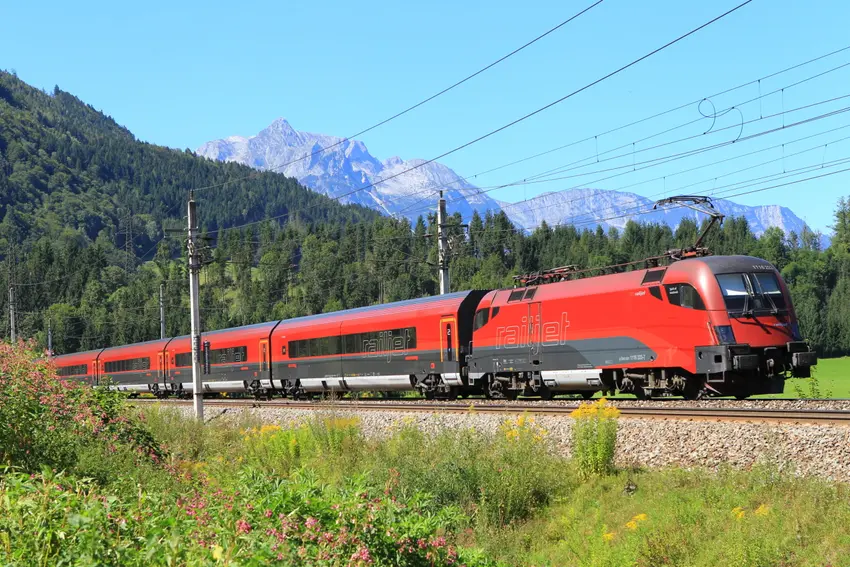
The new trains were shown on Wednesday during a premiere journey from Vienna Hauptbahnhof to Wiener Neustadt, ORF Lower Austria reported.
By the end of 2026, 45 new double-decker trains are expected to be in service in Austria’s eastern region.
Where will the new trains run?
The new Cityjet double-decker trains will first be used on the route from Vienna to Payerbach-Reichenau in the district of Neunkirchen from the end of June.
In the longer term, their main area of use will be the north-south axis in eastern Austria.
That includes REX services from Znojmo and Retz via the Nordwestbahn, as well as from Břeclav and Bernhardsthal, continuing through Vienna towards Wiener Neustadt and Payerbach-Reichenau.
For commuters in Lower Austria and Vienna, the main point is capacity. ÖBB said the new trains should offer up to 25 percent more seats than their predecessors.
READ ALSO: REVEALED: The big changes for train travel in Austria in 2026
More seats and space for bikes
ÖBB is buying 109 new train sets in total, with an investment of around €1.5 billion.
A six-car train will carry around 591 passengers, while a four-car version will carry around 371 passengers. The trains, supplied by Swiss company Stadler, can travel at speeds of up to 160 km/h.
They are also designed with low-floor entry areas, which should make boarding and leaving the train easier for passengers with reduced mobility, pushchairs or heavy luggage.
Each carriage will have multi-purpose areas for pushchairs and bicycles. A six-car train will be able to carry up to 60 bicycles.
The trains will also include two wheelchair spaces with height-adjustable side tables, as well as an accessible toilet with a changing table.
READ ALSO: Major investments: How Austria plans to improve train travelling by 2040
Why is ÖBB adding them?
ÖBB chief Andreas Matthä pointed to high demand in eastern Austria during the presentation. He said around two-thirds of the company’s total local transport service was in the eastern region.
Transport Minister Peter Hanke, from the Social Democrats, described rail as an “elementary lever” in the shift towards more sustainable mobility.
Lower Austria’s deputy governor and transport councillor Udo Landbauer, from the far-right FPÖ, said the new trains would bring more capacity, meaning “less crowding, less stress, more quality of life on the way to work”.
Florian Krumböck, an ÖVP member of the Lower Austrian state parliament speaking on behalf of Governor Johanna Mikl-Leitner, also highlighted the role of rail transport for Lower Austria.
ÖBB said the new double-decker trains are part of what it described as the largest investment programme in the company’s history. The wider programme includes €6.1 billion for around 330 new trains by 2030.
READ ALSO: Train travel in Austria: The best day trips from Vienna
Key vocabulary
der Doppelstockzug – double-decker train
die Garnitur – train set
der Nahverkehr – local or regional public transport
der Kinderwagen – pushchair or pram
barrierefrei – accessible, especially for people with reduced mobility
die Mobilitätswende – shift towards more sustainable transport
Comments