
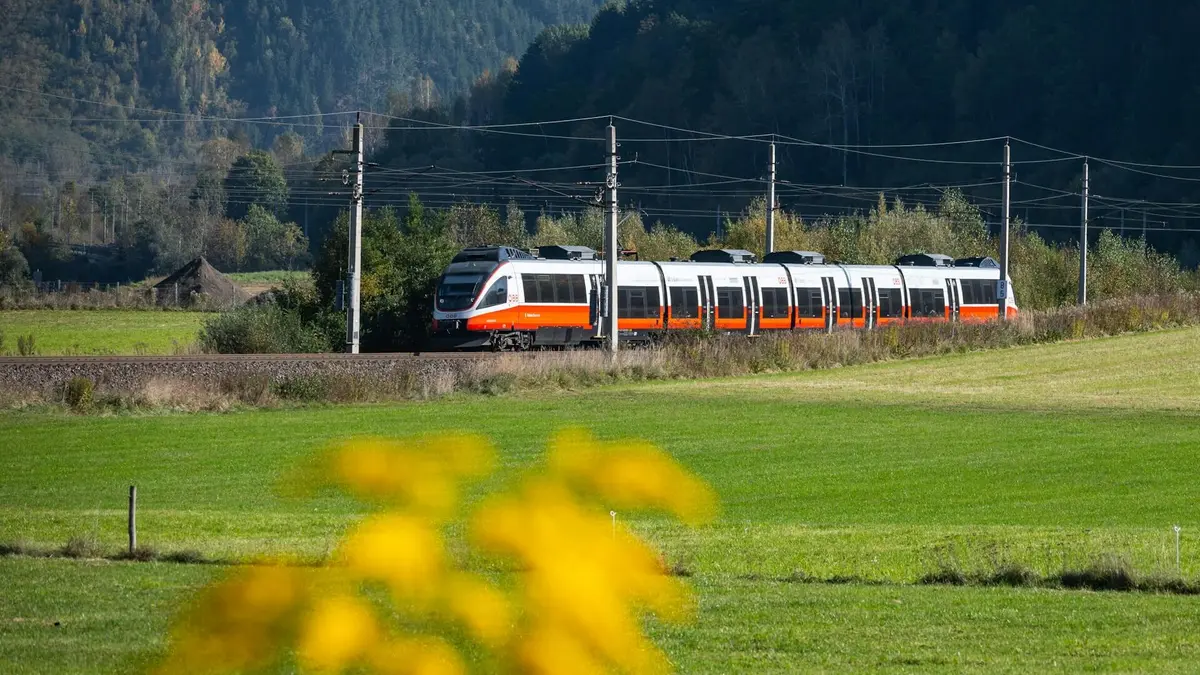
Austria is on a mission to modernise and improve its railway system.
During the upcoming years, focus and resources will be put on expanding capacity, improving international and regional connections, and contributing to the country’s achievement of its climate goals by 2040.
In the near future, you will be able to travel faster to places both inside and outside the country, enjoy new and comfortable trains, and travel more sustainably.
Convenient international connections
Austria's national rail operator, ÖBB, and the federal government have laid out plans to expand and modernise the country's railway system.
The current most significant strategy is Target Network 2040, which aims to improve Austria's railway infrastructure significantly.
With a planned investment of €26 billion, ÖBB wants to reduce travel times, improve punctuality, increase the number of trains and seats, modernise stations, and eventually make travelling easier, faster, and carbon-neutral.
One of the main goals is to improve international connections, especially with Germany, Switzerland, and France.
The company intends that the improved conditions will raise the total distance travelled by train to 255 million kilometres annually within the next 20 years, representing a 50 percent increase over current usage levels.
The plan involves 67 initiatives across 25 main areas, with the most significant ones being:
- A new double-track line that will reduce travel time between Vienna and Munich from four hours to 2.5 hours.
- Improved regional connections to the centre of Linz, leading to faster cross-border travel, especially to destinations such as Paris.
- Expanded railway lines around Bregenz.
- Optimised long-distance routes to Innsbruck and Zurich via Munich.
READ MORE: Five European cities you can reach from Austria in less than five hours by train
View this post on Instagram
Improved routes within the country
The government and ÖBB also focus on more immediate improvements and projects, and ÖBB Framework Plan 2024-2029 is an integral part of this effort.
With an investment of €21.1 billion, Austria's railway infrastructure will significantly improve by 2029.
Important projects such as the Semmering Base Tunnel, Koralm Railway, and Brenner Base Tunnel will continue. The goal is to increase capacity and make it easier to travel across Austria and beyond.
The projects will improve and shorten travel times between Graz and Klagenfurt, Vienna and southern Austria, and between Austria and Italy.
New lines, such as the Köstendorf-Salzburg line, are also planned to improve regional travel by reducing travel times. In the future, it will take less time to travel between different parts of Austria, such as Salzburg city and other towns in the province.
Apart from improving connections and travel time, the Framework Plan also focuses on Austria’s commitment to sustainability and plans to electrify 500 kilometres of rail lines by 2030, working towards a fully decarbonised railway system.
READ ALSO: What to know about new night train connecting Belgium, Germany, Austria and Italy
330 new trains on their way
Last year, ÖBB announced that they will invest around €6.1 billion in new and modern trains by 2030.
This refers to around 330 new trains and more than 100,000 modern seats over the next few years.
In 2023, ÖBB ordered 14 Railjet double-decker trains, intending to significantly increase seating capacity by 2026. The Railjet is also planned to be given an even more modern design.
ÖBB will upgrade its 60 existing Railjet trains this year by improving their design, interior, technology, and telematics systems.
In addition, the company is planning to invest around €743 million to increase traffic with 47 additional Cityjet double-decker trains.
Another significant milestone in the decarbonisation plan is last year's investment in 16 new battery-powered trains, which will replace diesel services on the Kamptalbahn line in Lower Austria by 2028.
READ NEXT: Fact check: Just how punctual are Austrian trains?
Comments