
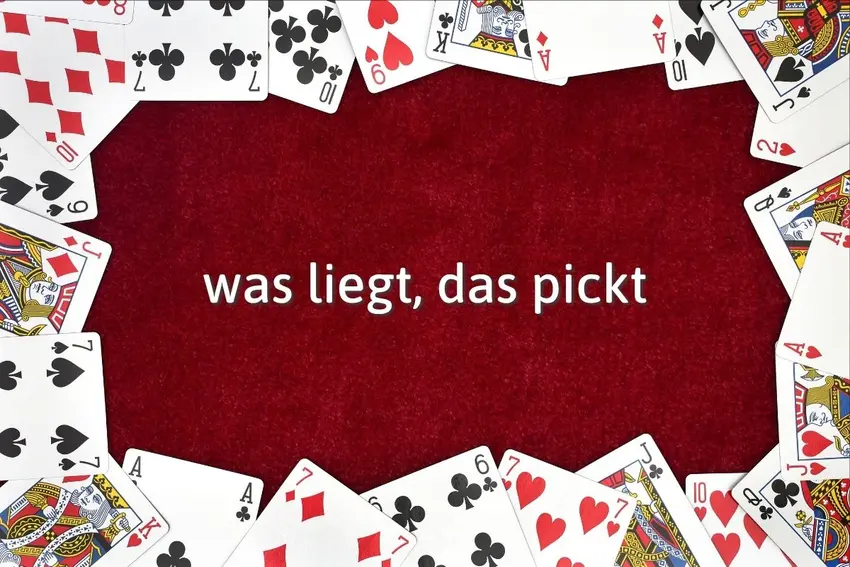
Why do I need to know Was liegt, das pickt?
This is a distinctly Austrian expression, often used in everyday speech, politics, business, legal discussions and card-playing contexts.
It means that once something has been agreed, said, decided or put down, it stands. In English, you might translate it as “what’s done is done”, “a deal is a deal”, or “you can’t take it back now”, depending on the situation.
It can sound firm, resigned, humorous or slightly stubborn. You might hear it after someone has signed a contract, made a choice, placed a card on the table, or committed themselves to a plan.
What does it mean?
Was liegt, das pickt literally means “what lies there, sticks”.
The key word is pickt, from picken. In Austrian German, picken can mean “to stick” or “to be stuck”, rather than only “to peck” as learners may know from standard German. Duden also lists picken with the meaning “to stick” or “to glue”.
The expression is strongly associated with Austrian usage. Wiktionary defines it as meaning that something already done or said can’t be reversed, or that what has been agreed must apply.
Its background is often explained through card games: once a card has been laid on the table, you can’t take it back. Outside card games, the expression is now used more broadly for anything considered binding. That could be a verbal agreement, a political deal, a signed contract, or simply a choice someone now has to live with.
Use it like this:
Du hast zugesagt, also kommst du auch mit. Was liegt, das pickt.
You said yes, so you’re coming along. A deal is a deal.
Ich habe den Mietvertrag unterschrieben. Was liegt, das pickt.
I’ve signed the rental contract. What’s done is done.
Beim Schnapsen gilt: Was liegt, das pickt.
In Schnapsen, the rule is: once the card is down, you can’t take it back.
It’s a very Austrian way to say that a decision has been made - and now everyone has to stick to it.
Comments