
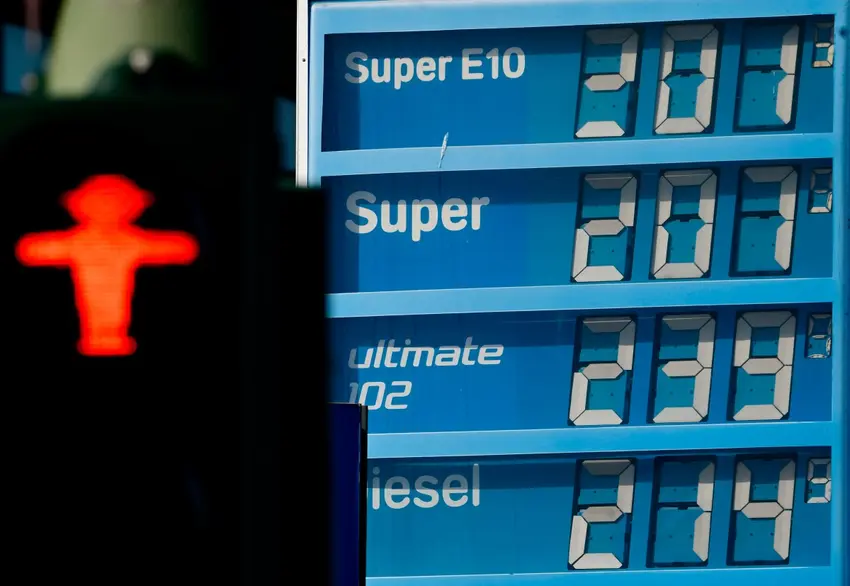
Austria's ÖVP-SPÖ-NEOS coalition announced a plan thatcombines two ideas they had been debating for days: a small cut to the mineral oil tax and the option to freeze profit margins along the fuel supply chain in a crisis. The package is meant to ensure that neither the state nor energy companies benefit disproportionately while consumers face sharply higher prices.
Austria is now focusing on creating a crisis tool that will also work in the future and could be called on whenever needed (with not as much bureaucracy).
The government wants to step in when prices rise sharply and use tax changes and margin controls to dampen the increase.
What exactly is the government planning and how will it impact prices?
The first part of the package is a tax cut. The government said the mineral oil tax on petrol and diesel would initially be reduced by 5 cents per litre.
Then, there's a legal mechanism that allows the government, or the finance minister, to limit operating margins across the value chain when a crisis exists. The state wants the power to stop refiners, wholesalers or others in the chain from using a crisis to expand their margins too far.
Taken together, the coalition said the relief should add up to around 10 cents per litre. The coalition said this could mean around €5 on an average tank fill.
During a press conference to present the plan, Chancellor Christian Stocker said the aim was for no one to profit from turmoil in the oil markets while people suffered from rising prices. Vice-chancellor Andreas Babler said the chosen model was also meant to protect supply. Foreign Minister Beate Meinl-Reisinger stressed that these were not absolute price caps and described the approach as “close to the market”, because it would not completely override price signals.
READ ALSO: Essential tips to help you save money on fuel in Austria
When can these measures be used?
Under the planned legal change, a crisis exists if petrol or diesel prices rise by more than 30 percent over a period of two months. In that case, the government would be able to act by regulation.
It's a relatively high threshold that the politicians said would ensure measures would be taken only after the sort of sustained surge linked to international disruption – like the war in the Middle East following the US-Israeli attack on Iran, which has caused major volatility on global oil and gas markets.
The government also built in an escape clause. If either of the measures threatens the security of supply, both can be suspended at any time.
What happens next?
The measures are due to be approved by parliament next week.
A special sitting of the Nationalrat is expected on Monday to introduce the legal changes. A formal vote is then due in one of the chamber’s regular sittings on Wednesday or Thursday, followed by a special sitting of the Bundesrat on Friday to make sure the package can enter into force on time.
If that timetable holds, the changes would take effect on April 1st.
READ ALSO: Cost of living: 45 ways to save money in Austria
How does this fit with the current fuel-price rules?
Austria has already introduced a separate short-term measure affecting petrol stations. Since the start of this week, stations have only been allowed to raise prices three times a week, on Mondays, Wednesdays and Fridays at 12 pm. They can still cut prices at any time.
That rule expires on April 12th. The new package goes further by creating a broader framework for tax reductions and margin controls in a crisis.
Fuel prices had already eased slightly in recent days. ORF said the nationwide average diesel price was €1.988 per litre on Monday and €1.964 on Tuesday, while super petrol fell from €1.785 to €1.760.
Key vocabulary
Mineralölsteuer – mineral oil tax on fuels such as petrol and diesel
Margen – profit margins
Wertschöpfungskette – value chain, meaning the different stages from production to sale
Nationalrat – the lower house of Austria’s parliament
Bundesrat – the upper house of Austria’s parliament
Versorgungssicherheit – security of supply
Comments