
From Austria to Sweden by train: would you take it on? For a holiday maybe? But for work?
I decided to embrace this adventure when I learned I would have a conference to attend in the southern Swedish city of Kalmar.
The reasons? Well, I’ve got to say a pretty important one: the institution where I work, the University of Vienna, encourages academic staff to use trains instead of flights for conferences and meetings, when possible, for environmental reasons.
This is not a rule when the city is more than six hours away by train, but I still thought, if I was given the choice then it was only fair to try. After all, I had done a similar trip to southern France before for the same reason, and Kalmar would be just a few more hours away.
Plus, I was excited about crossing four countries on my way and catching a glimpse of each from the window of the train.
READ ALSO: Which train operators in Austria are the worst for delays and cancellations?

The first tip for multiple train journeys: get an Interrail ticket
I already had some experience travelling by train in Europe, so I knew the best way to book the trip. You can buy tickets for each leg separately from each train company you are taking, but you always risk encountering problems if one of the trains is late and you miss the next one, as buying a single ticket covering such a long trip is impossible.
So, I went directly for an Interrail ticket, which had worked well for me on a previous work-related trip. A train ticket for the round trip would cost around €300 without seat reservations, while taking a plane to Copenhagen and then the train to Kalmar would not be much cheaper, especially if you don't book way in advance.
With those, I could choose all the legs I wanted in advance and only book extra reservations when specifically required. I felt safer knowing I could make last-minute changes if necessary.
The route
The trip took me through some major cities. Starting in Vienna, a 10-hour train journey took me to Hamburg. From there, I took a night train to reach Malmö in six hours and then Kalmar after another three hours.
Similarly, on the way back, the first leg to Malmö took me three hours. The second was on a night train to Hamburg, which took around six hours. From there, I went to Frankfurt (about four hours) and then Vienna (some seven hours).
The second tip: find things to do with all the free time
If I hadn't decided to make an extra short stop for lunch on the way home, the trip would have taken around 23 hours on the way there (from the moment I got on the train to the moment I arrived at my destination) and 22 hours on the way back. There was a lot of waiting in train stations, both to take a break and so that I had some leeway in case any legs were delayed—I didn't want to miss my next train.
The combo flight to Denmark and then train to Kalmar, which is one of the quickest ways to reach the city from Vienna, would have taken me about eight hours.
This meant I had to be well-prepared with things to do during the journey. I had plenty of work tasks, but I also took some time to pause and enjoy the view.
The internet worked well on all the trains, which isn’t always the case. I like to bring my own snacks, but the restaurants on the trains have enough to offer and provide a cosy spot for hungry travellers.
The staff on all the trains I took were extremely friendly, which definitely made the trip better. It was quite nice to meet people coming and going, each with their own destinations and reasons for travelling.
Some were going further than I was by train or had already been touring Europe for a while.
READ ALSO: Major investments: How Austria plans to improve train travelling by 2040
Of course, I planned to take at least one leg on a night train, both on the way there and back (for the Hamburg-Malmö stretch). The chance to lie down and sleep was really important to avoid being exhausted for the conference.
I booked a bed in a cabin for six people. It was pretty cramped but sufficient for the short time there. Depending on your sensitivity to sleeping, it can be a positive or negative experience.

They provide breakfast on the train, which you can book in advance, but I preferred to wait and grab some coffee and fresh Swedish pastries at a stop before my next train.
The downsides and delays
I must say I was a bit disappointed by the flat landscape — well, crossing the Alps on my way from Vienna to southern France on a previous trip was hard to beat.
But it was nice to see the cute little villages, surrounding nature, and two beautiful sunsets.
READ NEXT: What I learned taking the train through Europe with two kids
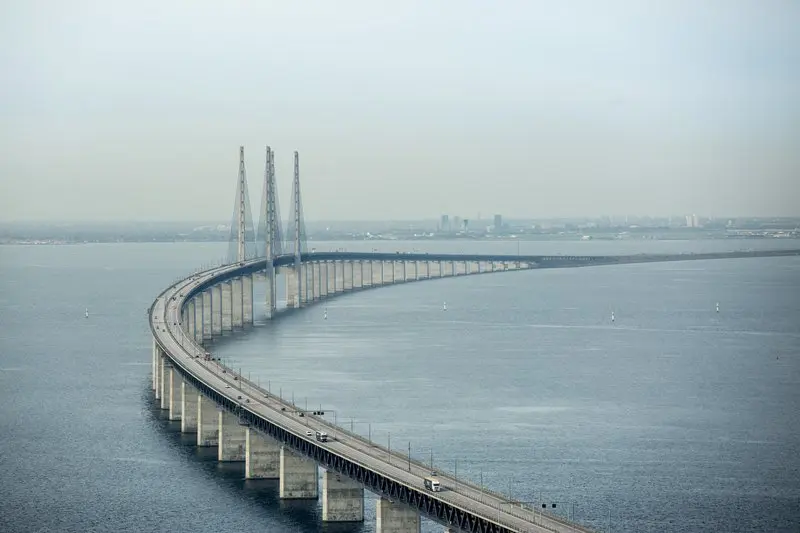
It was particularly special to wake up in the morning while crossing the Øresund Bridge (from Denmark to Sweden).
The trains were often not on time either. I had heard about this issue, so I planned what I thought was plenty of time for transfers. The worst delay was a train that arrived 70 minutes late and at a different platform than announced, forcing me and other passengers to suddenly run to the opposite side of the station in Hamburg (Germany).
But the most stressful moment was on my way back, when my first train from Kalmar to Malmö was 40 minutes late, and I had only 38 minutes planned for my connection.
How naive!
I was very anxious, as missing that connection would have meant either spending the night at the station or looking for a hotel at the last minute and consequently missing all the other connections afterwards. But lucky me: since delays turned out to be the norm, the night train was also quite late, which gave me plenty of time to reach the right platform and still catch it.
READ ALSO: Five European cities you can reach from Austria in less than five hours by train
And the best things about train travelling
One of the perks of travelling by train is the flexibility in your schedule. It was smart to plan some stops to move around and eat. On my way back, I stopped for lunch in Frankfurt for two hours and managed to meet a close relative I hadn’t seen in a while, something I couldn’t have done if I had taken a flight.

On my very last train, I took some time to watch an online documentary that caught my attention about 200 years of German immigration to South America.
The story was very similar to that of my family, who migrated from southern Bavaria to Brazil between World Wars. By the end of the video, I looked out the window and emotionally realised that I was, at that exact moment, crossing Bavaria, the land of my ancestors.
This made me appreciate the trip even more and connected me to the territory on a very personal level.
Arriving in Austria was smooth but late—as one might expect.
I think the sentence “we apologise for the delay” was the one I heard most during the whole trip, either on the trains or while waiting at the platforms.
READ ALSO: What to know about new night train connecting Belgium, Germany, Austria and Italy
You need to be mentally prepared for delays and have some backup plans.
An average delay was 30 minutes, so although waiting long in the stations isn’t ideal, planning tight connections would have only made the experience more stressful.
Overall, the trip was really enjoyable, and the time passed faster than expected.
It was a great way to avoid airport hassles, take some time to work, connect with the landscape, and travel in a much more sustainable way.
I hope authorities recognise the importance of investing in improving train systems and making train trips more affordable.
In my case, I had the privilege of being sponsored for this trip by the Centre for Teacher Education at the University of Vienna, for which I’m very grateful. If more institutions and companies were willing to support green travelling, we could still benefit from in-person work-related events while making work travel more planet-friendly.
This story was written by Valéria Schörghofer-Queiroz. Would you like to submit your own reader's insight about living, working and travelling in Austria? Send us an email news@thelocal.at.
Comments (2)