
The Austrian citizenship test is an exam designed to demonstrate an applicant’s knowledge of Austria. It was introduced in 2006.
It covers the democratic system, the national history and regional facts about where an applicant lives.
Would you pass?
The questions are in German, but we have translated them here so more people can try them out. Also unlike the actual examination, there is no time limit to answer the exam. These are sample questions from the official online practice test.
Austria has nine federal provinces, each with its own province-specific citizenship questions. This quiz focuses on the two nationwide subjects, Austrian history and democracy.
The real exam has 18 multiple-choice questions, with six from each of its three sections. Candidates have two hours to complete it. To pass, they must score at least half the available points in each section or at least two-thirds overall.
READ ALSO:Austrian citizenship: Do you really have to renounce your original nationality?
Now it's time to test your knowledge:
To which large empire did Austria belong for almost 500 years?
a) Roman Empire
b) Egyptian Empire
c) Chinese Empire
d) Persian Empire
Austrian parliament after five years of renovations. (© Amanda Previdelli / The Local)
Answer: (a) Roman Empire
The area that is now Austria was home to several Celtic kingdoms that eventually became part of the Roman Empire from the year zero of our era. The Danube was the border of the Empire at the time.
The revolutions throughout Europe in 1848 also affected the Austrian Empire. What were the main demands of the 1848 revolution? Choose three.
a) Freedom and civil rights
b) A constitution
c) More rights for the emperor
d) Independence from the Austrian Empire (e.g. Hungary)
Photo: Pixabay
Answer: (a), (b) and (d)
The 19th century saw major economic and political changes. Austria became a modern state. Over time, a unified administration emerged with schools, courts and tax offices.
Many people were murdered in concentration camps during the Nazi era. Where was the largest concentration camp on the territory of present-day Austria?
a) Graz
b) Wien
c) St. Pölten
d) Mauthausen
The Austrian national flag hoovers in Vienna. AFP PHOTO / ALEXANDER KLEIN (Photo by ALEXANDER KLEIN / AFP)
Answer: (d) Mauthausen
The largest concentration camp complex on the territory of present-day Austria was Mauthausen, in Upper Austria. Around 190,000 people were imprisoned at Mauthausen and its subcamps between 1938 and 1945, and at least 90,000 died, according to the Mauthausen Memorial.
What characterises a liberal state? Choose two options.
a) A life in the greatest possible freedom
b) People are allowed to do what they want, even if they harm other people in the process
c) People can make certain decisions for themselves, e.g. choice of profession or study
d) There are no laws
People crossing a street in the Austrian capital, considered one of the worlds happiest cities. Photo by Jacek Dylag on Unsplash
Answer: (a) and (c)
A liberal state makes it possible for its citizens to live in the greatest possible freedom. To achieve this, limits are set for the state. This means that the state is not allowed to intervene in many areas of life so that citizens can have a "state-free" sphere of life.
Which reforms changed Austria in the 1970s? Choose two.
a) Compulsory education
b) Equal rights and duties for men and women
c) Expansion of schools and universities
d) Ban on smoking in public places
A biker riding outside the parliament in Vienna. (Photo by Joe Klamar / AFP)
Answer: (b) and (c)
Austria's economic success between 1950 and 1970 meant that many people moved from the countryside to the cities. And many workers came to Austria from abroad. Modern industrial and service companies sprang up. This also changed society.
From what age can Austrian citizens vote? Choose one answer.
a) Women aged 18
b) Men aged 18
c) Women and men aged 16
d) This depends on the respective federal province
Assessors count votes at a polling station, after the European Parliament elections in Palma de Mallorca on June 9, 2024. - (Photo by JAIME REINA / AFP)
Answer: (c)
All Austrian citizens have the right to elect their political representatives at the federal level, in their respective province, in their own municipality as well as members of the European Parliament from their 16th birthday.
Who is the Head of State of the Republic of Austria?
a) The Federal President
b) The Federal Chancellor
c) The Governor of the Province
d) The President of the National Council
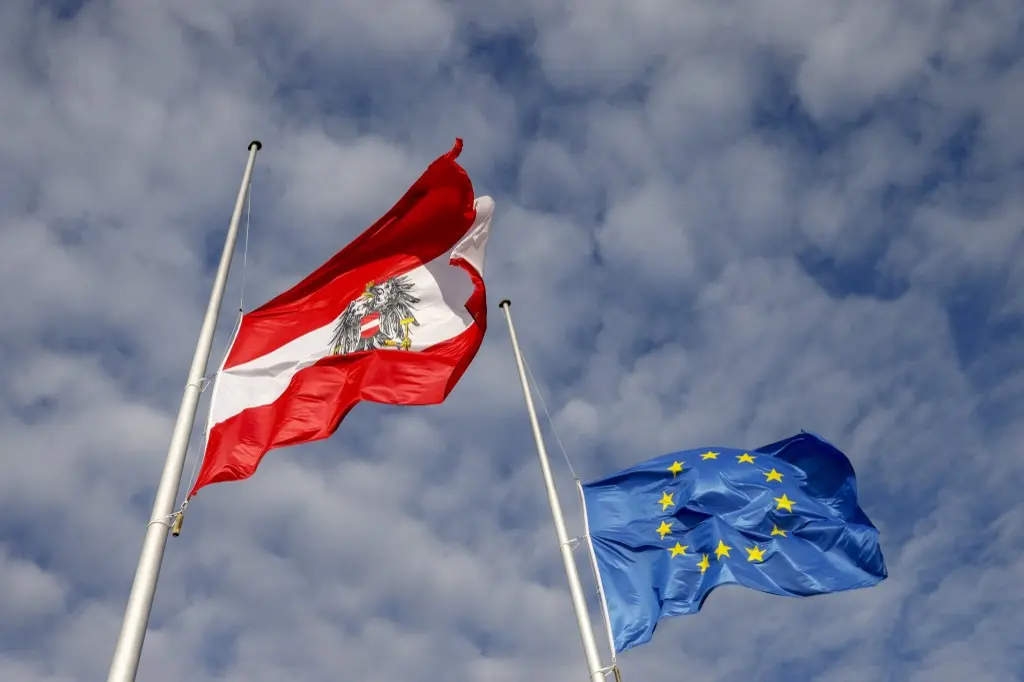
An Austrian and a European flag flutter in the wind. (Photo by Odd ANDERSEN / AFP)
Answer: (a)
As Head of State, the Federal President represents the Republic of Austria at home and abroad. In Austria, the Federal President is elected directly by the people. The term of office lasts six years.
Where are the rules laid out for which tasks the federal government and the federal states are responsible?
a) In the European Convention on Human Rights
b) In the Austrian Federal Constitution
c) In the Decisions of the European Union
d) In the Charter of the United Nations
A statue of the goddess of Justice balancing the scales. (Photo by Damien MEYER / AFP)
Answer: (b)
The Austrian Federal Constitution defines the tasks of the Federation and the states. It is important to distinguish between the passing of laws and the implementation of these laws. For example, the federal level is responsible for areas such as foreign affairs, federal finances, customs and defence. The federal provinces have responsibilities of their own and also implement many federal laws.
Why is the division of state power important in Austria? Choose two answers.
a) So that the state does not abuse its power vis-à-vis the population
b) So that the power of the state is not concentrated in one place
c) So that the economic output remains the same
d) so that the media are controlled
An inner view shows the Austrian Parliament in Vienna on December 20, 2022. (Photo by VLADIMIR SIMICEK / AFP)
Answer: (a) and (b)
In Austria, state power is divided between the legislature, which makes laws, the executive, which implements them, and the judiciary, which includes the courts. This division helps prevent power from being concentrated in a single institution.
Which of these are institutions of the European Union?
a) European Commission
b) Supreme Court
c) Constitutional Court
d) European Parliament
Photo by ALEXANDRE LALLEMAND / Unsplash
Answer: (a) and (d)
Since 1995 Austria has been a member of the European Union (EU). As a result, there are many political decisions and many laws that are no longer determined in Austria itself but by the European Union. In order for the European Union to make decisions, it has its own institutions. The most important institutions of the EU are the European Commission, the European Council, the Council of the European Union and the European Parliament.
Comments