
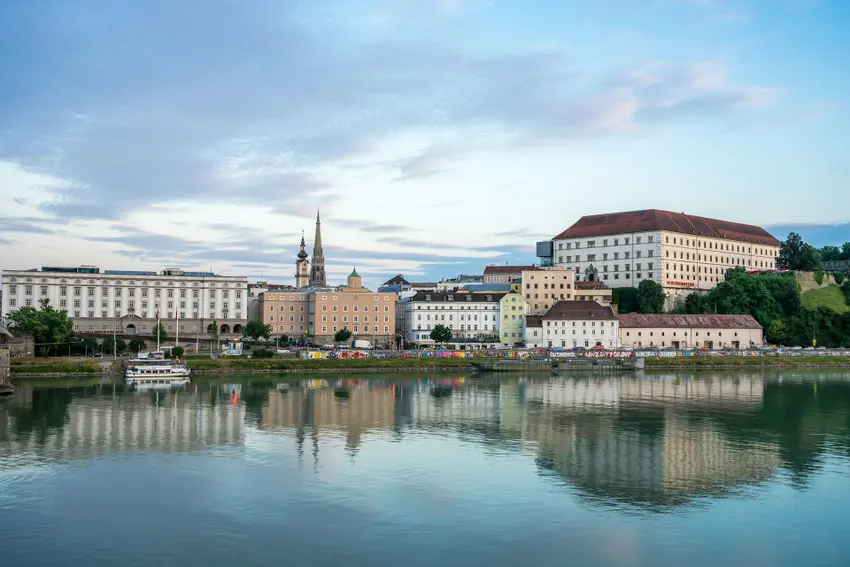
Linz may not have the international profile of Vienna or Salzburg, but Austria’s third-largest city has plenty going for it as a place to live.
Set along the Danube, the Upper Austrian capital is a major industrial and business centre and has also become an important hub for technology companies and other international employers. For people moving there for work or looking beyond Austria’s more expensive cities, the cost of living can be part of the appeal.
Housing will usually be the biggest variable in the monthly budget, but transport and childcare can be relatively affordable for people registered in the city.
So what should you actually budget to live in the Upper Austrian capital?
How much does it cost to rent in Linz?
According to ImmoScout24’s analysis of rental listings, the median advertised rent in Linz was €15.51 per square metre.
That figure is a Bruttomiete, meaning the basic rent plus building running costs (Betriebskosten). Heating and electricity are not included.
As a rough illustration, applying the €15.51 figure to different flat sizes gives you:
50 square metres: about €776 a month
70 square metres: about €1,086
90 square metres: about €1,396
Linz was noticeably cheaper in the same ImmoScout24 dataset than Vienna, where advertised rents reached €22.45 per square metre, Salzburg at €21.96 and Innsbruck at €24.23. Graz, at €15.15, was slightly cheaper than Linz.
The City of Linz also points to the city’s substantial stock of non-profit and subsidised housing. It says 1,117 homes were completed in the city during 2025 and almost 1,900 more were under construction at the end of the year.
READ ALSO:IN NUMBERS: Where are Austria's most budget-friendly cities?
What should you budget for public transport?
Transport is one area where living in Linz can be relatively inexpensive, particularly once you've registered the city as your main residence.
A normal monthly pass for the Linz public transport network costs €64.50 in 2026, according to LINZ AG.
But residents with their Hauptwohnsitz, or main registered residence, in Linz can get the city's subsidised transferable MEGA annual pass for €285, just about €23.75 a month. The pass covers unlimited travel within Linz's core zone and includes the Pöstlingbergbahn.
Lower-income residents may pay even less. Linz's Aktivpass is available in 2026 to adults with their main residence in Linz and monthly net income of no more than €1,630. Holders can buy a monthly public transport pass for €17.80.
READ ALSO:How Austria's public transport fare rises will hit commuters and day-trippers
What about food and everyday spending?
That's much harder to compare, as it depends heavily on each household (living standards, preferences and size)
We can check, though, Statistics Austria’s latest household budget survey which found that Austrian households spent an average of €484 a month on food and non-alcoholic drinks in 2024/25.
Electricity and heating also need to be considered separately from the advertised rent figure above. How much they add also depends on the size and energy efficiency of your home, the heating system, your consumption and your individual energy contract.
That makes the energy information in the flat itself important when comparing properties. Two homes with similar advertised rents can produce rather different total monthly housing bills.
READ ALSO:In numbers: What's a 'normal' monthly budget in Austria in 2026?
How much does childcare cost in Linz?
Under Upper Austrian rules, kindergarten is contribution-free until 1 pm for children up to school age. Parents pay for afternoon care after 1 pm.
The provincial calculation allows an afternoon fee of up to €132 a month, depending on household income. Linz provides a family subsidy based on its former tariff model, which means the afternoon contribution for Linz families can currently be no more than €74 a month.
Food is charged separately. For children living in Linz, the monthly meal contribution ranges from €28.31 to €99.07 depending on household income. Municipal kindergartens also charge a €58 annual materials fee.
READ ALSO:How does childcare work in Austria?
So how much do you need to live in Linz?
For someone renting alone, the key number is usually the flat and its costs. A 50-square-metre home at the 2026 advertised city-wide median works out at roughly €776 before heating and electricity, while a larger 70-square-metre home comes to around €1,086.
A couple sharing can obviously make the same apartment considerably cheaper per person. Families will need more space and money, although free morning kindergarten and subsidised public transport can keep some other recurring costs relatively low.
For a realistic Linz budget, start with the rent on the kind of flat you would actually take, then add energy, transport, food and any childcare costs.
READ ALSO:IN NUMBERS: What is considered a good salary in Linz?
Key vocabulary
Bruttomiete - gross rent, usually the basic rent plus building running costs
Betriebskosten - building running or operating costs charged alongside rent
Hauptwohnsitz - your officially registered main residence
Aktivpass - Linz's discount pass for residents on lower incomes
Comments