
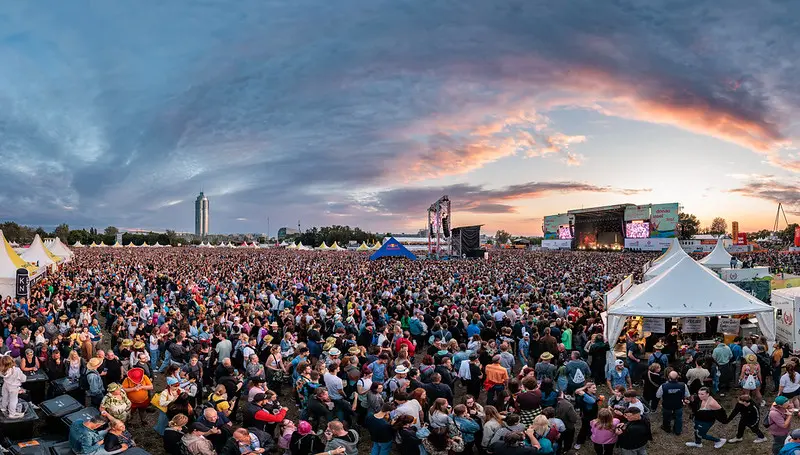
The festival is now in its 43rd edition and describes itself as Europe’s largest open-air festival with free entry. According to the official Donauinselfest FAQ, the 2026 festival site stretches for 4.5 kilometres between the Floridsdorfer Brücke car park and the Reichsbrücke.
This year’s programme includes 14 stages, 16 themed islands, around 200 acts and more than 700 hours of entertainment.
But for visitors, especially newcomers to Vienna, the most useful things to know are less about the line-up and more about getting there, what you’re allowed to bring, and where to get help if something goes wrong.
READ ALSO:Donauinselfest: What you need to know about Austria's biggest open air festival
How to get there
Organisers strongly recommend using public transport since it's easier and because there are hardly any parking spaces near the festival site.
The main access points are via Handelskai on the U6 and S-Bahn/regional trains, Neue Donau on the U6, and Donauinsel on the U1. If you arrive at Vienna Hauptbahnhof, the easiest route is usually the U1 to Donauinsel. From Westbahnhof, the U6 takes you to Handelskai or Neue Donau.
This year, travel is a bit more complicated because the festival falls on the first weekend of Vienna’s school holidays and coincides with works on the Vienna S-Bahn Stammstrecke, the main S-Bahn corridor through the city.
But according to ORF Vienna, an additional transport plan has been drawn up with Wiener Linien and ÖBB. In the night from Friday to Saturday, the S-Bahn will still run on the Stammstrecke until 2am. From Saturday, the U6, S45 and tram line 31 will run more frequently. The S45 will add capacity at Heiligenstadt, where passengers can connect to the U4.
A rail replacement service will also run around the clock between Floridsdorf, Handelskai, Traisengasse and Praterstern.
The festival website says U-Bahn service intervals will be reduced to three minutes in the evening to help people leave the site. Tram lines 25, 26 and 31, as well as bus routes 11A and 29A, will also have shorter intervals on Friday and Saturday night.
READ ALSO: What Vienna residents need to know about transport works in 2026
Can you come by bike or e-scooter?
Yes, but you can't take bikes, e-scooters or similar vehicles onto the festival site.
There will be five free and guarded ARBÖ bicycle garages at the Floridsdorfer Brücke, two at the Schnellbahnbrücke, one at the Brigittenauer Brücke and one at the Reichsbrücke. They are open daily from 2pm to 12:30am.
There are also temporary WienMobil Rad stations near the Floridsdorfer Brücke, Handelskai and Reichsbrücke.
What can you bring?
Bags and rucksacks are allowed only up to A3 size. Anything larger can be refused at the entrance. Small snacks such as fruit or cereal bars are allowed, but large meals are not. Non-alcoholic drinks may be brought in containers of up to 0.5 litres, and alcoholic drinks are not allowed.
There are free water dispensers across the site, including near several stage and island areas. Drinks bought on site will be served in reusable deposit cups, with a €2 deposit refunded when the cup is returned.
Umbrellas are banned, including small folding ones. Organisers recommend bringing a rain poncho instead. If it rains, ponchos may also be handed out on site while stocks last.
Also banned are knives, weapons, pyrotechnics, glass bottles, cans, drones, laser pointers, pepper sprays, drugs, large bulky objects such as folding chairs, and loud items such as megaphones or air horns.
Pets are generally not allowed, except trained guide dogs and assistance dogs.
READ ALSO: The best events in Vienna in June 2026
What is the security setup?
The festival will have a large security operation.
The site will be monitored using more than 40 cameras operated by the organiser and police, as well as three drone teams, ORF reported. The images will be sent to the security centre near the Floridsdorfer Brücke.
Several hundred police officers will be present, including uniformed officers, plain-clothes officers, patrol teams, drone teams, Cobra special unit officers and police boat crews. For the first time, police officers will wear blue shoulder lights to make them easier to spot in crowds and after dark. The system was already tested during the Eurovision Song Contest.
Police said there are no specific indications of a threat, but the general risk situation in Austria remains high. Visitors should expect access checks and possible bag searches.
Where can you get help?
The festival has an awareness system for people who feel unsafe, experience harassment, need a quiet place or want discreet help. Marked staff wearing “Ich bin dein Rettungsanker” stickers can be approached for support. This campaign was developed by the Vienna Women’s Service against sexual harassment.
There will also be a 24-person awareness team wearing magenta caps with “#dif Für Dich Da” on them.
Four Magenta Safe Zones will offer a protected space to calm down or get support. They are being supervised for the first time by the Vienna awareness collective AwA*.
If you need discreet help at a food or drinks stand, you can use the codeword “Angel Shot”. Festival chaplains and the drug counselling service checkit! are also part of the support network. The Inselnotruf, or island emergency number, is +43 1 270 04 20. In an emergency, the usual Austrian numbers also apply: fire brigade 122, police 133 and ambulance 144.
READ ALSO: Where can you cool down for free in Vienna this summer?
Key vocabulary
das Donauinselfest – Danube Island Festival
die Donauinsel – Danube Island
die Hausordnung – house rules or site rules
die Sicherheitskontrolle – security check
der Schienenersatzverkehr – rail replacement service
der Rettungsanker – “lifeline” or support point
Comments