
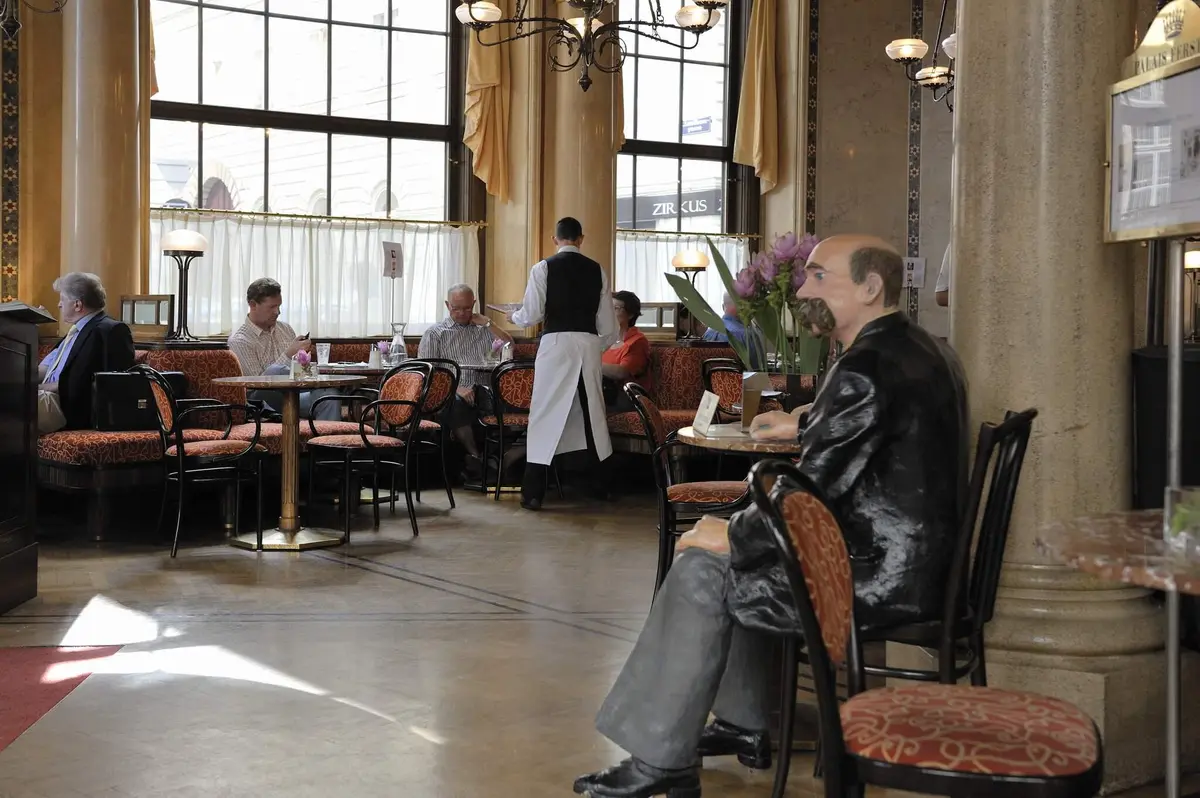
The historic café in Herrengasse closed its doors on Monday for renovations and will stay shut over the peak summer season. The works are set to focus mainly on ageing technical systems and infrastructure, while those behind the project insisted the look and character of the venue would remain unchanged.
Architect Peter Klein said a good renovation was one “where you notice nothing”. Martin Winkler, a board member at Verkehrsbüro, and managing director Kay Fröhlich also said the work would be carried out carefully.
That cautious approach is partly a matter of choice and partly a matter of law. Palais Ferstl, the building that houses Café Central, was originally built as a stock exchange building and is protected as a listed site. The café itself is also covered by heritage protection, leaving only limited scope for major visible changes.
READ ALSO: Q&A: How to make the most of Vienna's coffee culture
What will be renovated?
Much of the work will happen out of sight.
While the café’s columned hall and historic interior are part of its protected substance, the renovation is set to focus, above all, on ageing technical areas. Vienna.at reported that production and kitchen areas, as well as ventilation and fire protection systems, would all be fundamentally overhauled.
Some of the more visible historic details will also be restored. The Thonet chairs are to be refurbished, while the Backhausen fabrics will either be renewed or reproduced true to the original. The venue’s historic chandeliers will also be restored by specialist workshops.
The project will also create additional storage areas through a structural link to the neighbouring Palais Hardegg.
No precise figure was given for the total cost of the renovation, but Fröhlich said a double-digit million euro sum was being invested.
READ ALSO: IN PICTURES: The Vienna coffee shop where phone-less visitors get a discount
What happens to staff and guests?
Most employees are expected to remain at work during the closure.
Winkler said staff from Café Central would largely remain employed, with some temporarily moving to hotels within the group. The café is operated by Palais Events, a subsidiary of Verkehrsbüro.
For visitors, there will also be a temporary replacement. During the closure, a pop-up venue called Decentral will be open in Palais Harrach on the Freyung. It is set to offer, among other things, the café’s patisserie products.
Tourists and regulars will still be able to find (at least) part of the Café Central experience elsewhere while the original site is being restored.
READ ALSO: Five unusual cafes in Vienna you should not miss out on
One of Vienna’s best-known coffee houses
The closure is temporary, but it affects one of Vienna’s most recognisable coffee houses.
Café Central is one of the city’s most important tourist attractions. For many visitors hoping to experience a “typical” Viennese coffee house, it has long been a major stop. It is also famous for something many locals would never consider doing themselves: queueing outside to get in. In high season, the lines outside the entrance are strikingly long.
The café’s reputation goes back much further than tourism. It built its legendary status as a meeting place of Viennese modernism, with regulars around 1900 said to have included Sigmund Freud, Arthur Schnitzler, Hugo von Hofmannsthal, Leo Trotsky and Peter Altenberg.
This is not the first time Café Central has been shut for an extended period.
It has remained closed for far longer after the Second World War, reopening only in the 1980s after major renovation work. At first, only the arcaded courtyard was available.
Now, the building’s technology and infrastructure are being brought up to date, but the café’s operators said the atmosphere of the 150-year-old institution should stay intact.
READ ALSO: Caffeine, war and Freud: A history of Vienna's iconic coffee houses
Key vocabulary
Generalsanierung – full-scale renovation
denkmalgeschützt – protected as a historic monument or listed site
Luster – chandelier
Pforten schließen – to close one’s doors
Patina – the worn surface or aged finish that develops over time
Kaffeehaus – traditional Viennese coffee house
Comments