
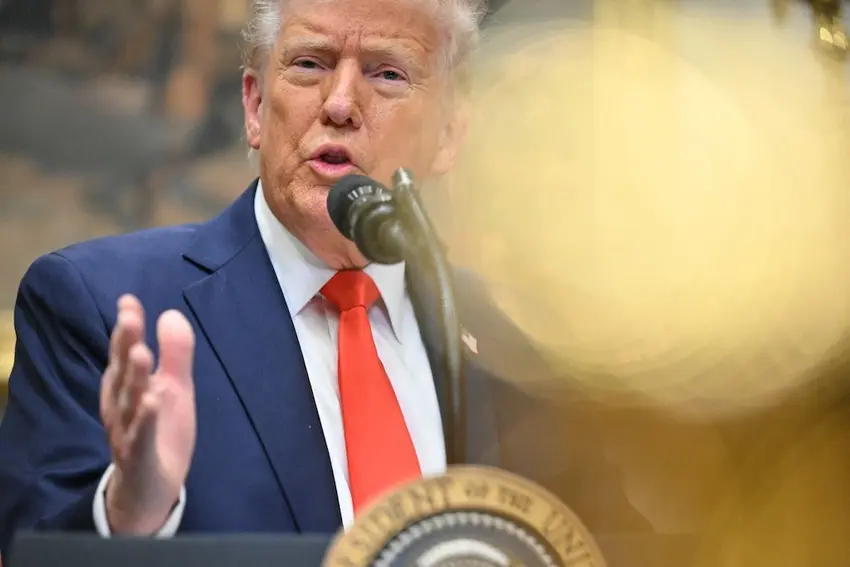
US President Donald Trump is once again rattling global markets—this time with the threat of steep tariffs on European wine, champagne, and other imports.
He says the aim is to retaliate against potential EU taxes on American whiskey as part of a broader trade dispute.
While the spotlight has mostly fallen on French champagne houses, Austrian wine producers and other exporters could face serious challenges.
Why the US market matters to Austria
Although Germany remains Austria’s largest export destination, the United States is now the second most important, making it a key pillar for Austrian goods abroad.
According to Kleine Zeitung, exports to the USA have risen recently. Machinery, vehicles, and pharmaceutical products are among the top categories. Overall, Austria exported €14.7 billion in goods to the US in 2023 alone.
READ ALSO: How Austria could feel the impact of Trump's return
Wine, while a smaller slice of the export pie, highlights Austria’s growing reach. In 2023, domestic producers shipped 65 million litres of wine worth €238.2 million, with 7.81 percent of that turnover heading to American shelves. Thus, the USA is the third most important market for Austrian wine after Germany and Switzerland.
Should Trump follow through on his threat of a 200 percent tariff on European wines, an attractive and growing revenue source for Austrian vintners could dry up considerably, as reported by Die Presse.
‘Austria particularly affected’
The President’s plans aren’t limited to beverages.
Christoph Neumayer, Secretary General of the Federation of Austrian Industries, warned that “Austria would be particularly affected” by US tariffs, given the significance of the American market. He called for a “smart deal” to avoid a “protectionist competition” that could spiral further, according to Kleine Zeitung.
Austria’s Institute for Economic Research (Wifo) economists share a similar concern.
On Austrian television, Gabriel Felbermayr, head of Wifo, said that a full-blown trade war would hit Europe “three times harder” than the US, specifically noting Austria’s strong trade ties. Austria has enjoyed a surplus in goods exports to the US since 2002, particularly in specialised industrial and mechanical products.
“Tariffs would therefore hit Austria hard,” Felbermayr warned in an interview with Kleine Zeitung.
READ ALSO: Checklist: How to move to Austria as an American
The steel factor and beyond
Beyond wine and whiskey, steel has become another battleground.
Trump’s earlier tariffs on steel and aluminium stoked fears across Europe, and Austria’s highly specialised steel producers have much to lose. They export more than 80,000 tonnes of steel products to the US each year—small in overall tonnage, but often in specialised categories that are difficult for American firms to replicate.
As steel expert Felix Schuler from Boston Consulting Group explained to Austrian media, “If US companies could supply the same quality at the same prices, then not so much would be imported right now.”
Many Austrian products fill a niche that US manufacturers can’t easily replace. However, they explained that higher import costs could force US buyers to turn elsewhere or simply pay more, potentially raising prices for American consumers and souring long-term relationships with Austrian suppliers.
What’s next for Austrian exporters?
For Austrian winegrowers, steelmakers, and machine builders, the short-term reality may involve less immediate collapse and more shifting strategies.
Companies that rely on American sales may need to find alternative markets or explore ways to absorb higher costs. Still, experts caution that rising tariffs and a protracted stand-off could strain supply chains and hamper growth as early as this year.
Wifo’s Felbermayr warns that, beyond trade policy, the United States under Trump has also demanded concessions from Europe on security issues—an indication that tariffs could become a bargaining chip for much larger geopolitical aims.
For now, Austrian exporters can only watch negotiations (and threats) continue. If there’s one lesson from Trump’s unpredictability, it’s that rhetoric can shift quickly—sometimes in a matter of hours.
Whether that means an eleventh-hour reprieve or a new wave of retaliatory tariffs is anyone’s guess. Still, Austrian producers have little choice but to brace themselves for a trade storm they can’t fully control.
READ NEXT: LISTED: All the things that will be more expensive in Austria in 2025
Comments