

Austria's far-right Freedom Party (FPÖ) has long been a controversial force in the country’s political landscape.
Known for its hardline stance on immigration and nationalism, the party now faces renewed scrutiny after a 196-page government-commissioned report linked it to right-wing extremist networks.
The findings, compiled by the Documentation Centre of Austrian Resistance (DÖW), cover the years 2020 to 2023 and paint a detailed picture of the FPÖ's proximity to far-right ideologies, organisations, and media, Austrian newspapers have reported.
The report, released after several delays, highlights concerning ties and patterns that have implications not only for Austria but for the international perception of its politics. Here's what the report uncovered and what it means for the FPÖ's future.
READ MORE: How Austria’s far-right FPÖ navigated 40 years of coalition highs and corruption scandals
The 'mosaic right': FPÖ as a key player
The report prominently features the term “mosaic right.” It describes a network of “alternative media, activist groups, and a party-political arm” that collectively promotes extremist far-right ideas.
According to Der Standard, the FPÖ is identified as a central component of this structure, with the report noting: “Since the coronavirus pandemic and Herbert Kickl's rise to power in the FPÖ, the Freedom Youth has also committed itself to this concept and rejected ‘distancing’ itself from the right-wing fringe.”
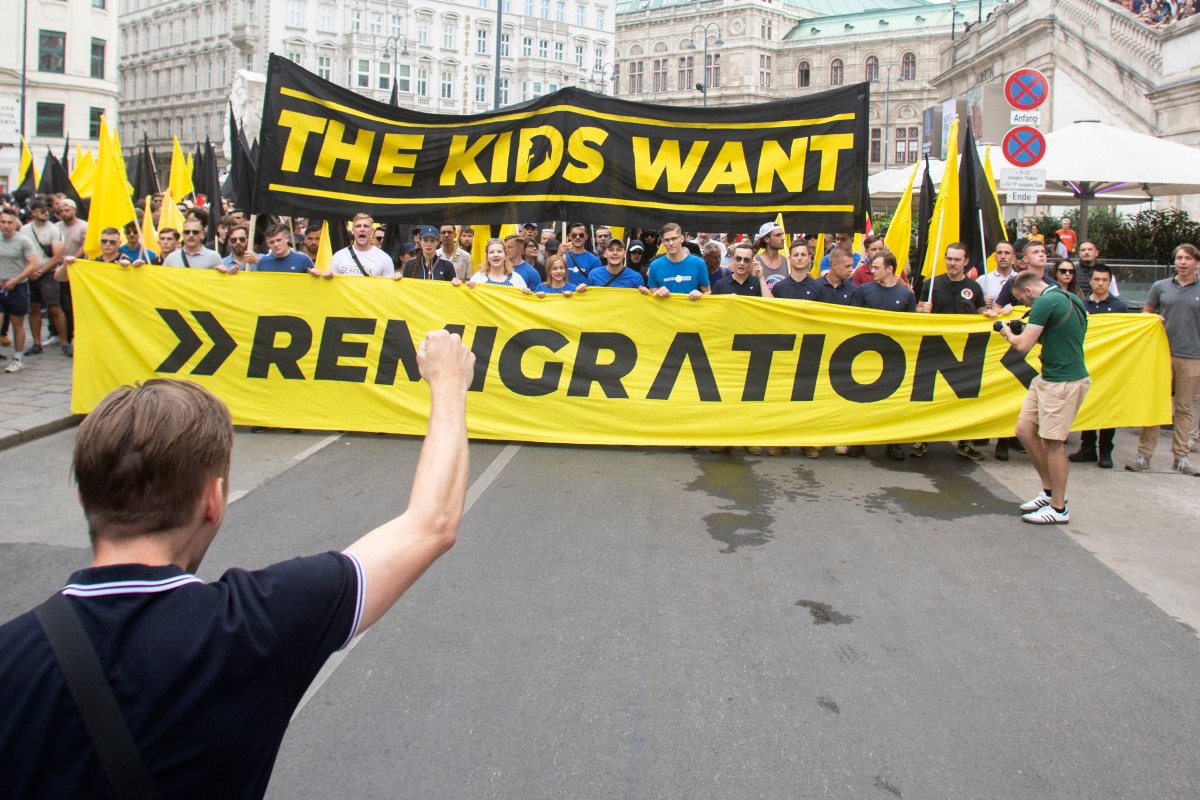
The FPÖ’s relationship with far-right activist groups like the Identitarian Movement (IBÖ) is particularly concerning.
The IBÖ, classified as a right-wing extremist organisation by the DÖW, has influenced FPÖ rhetoric and agenda. "Since 2019, the IBÖ has also increasingly succeeded in influencing the rhetoric, agenda, and positioning of a major parliamentary party (the FPÖ) in its favour," the report stated.
This relationship benefits both groups: the IBÖ gains a platform for its radical views, while the FPÖ taps into a street-level movement that amplifies its reach via protests and social media.
READ ALSO: 'Put Austrians first': Why Austria's far-right supporters stand behind the FPÖ
A historical connection to extremism
The FPÖ's ties to far-right ideologies are not new.
The party was founded in 1956, and its leadership included former National Socialists, such as Anton Reinthaller, a convicted war criminal.
According to the Die Presse, these historical links continue to resonate within the FPÖ today, particularly through its association with nationalist student fraternities and Austrian Landsmannschaften (ÖLM).
In the current Austrian Parliament, 17 members of the FPÖ are reportedly affiliated with these organisations, which the report describes as the “party-political arm of the nationalist associations.”
Media connections and the rise of alternative platforms
The report also sheds light on the FPÖ’s support for right-wing extremist media.
According to the DÖW, this relationship became “unprecedented in scope and quality” during the FPÖ’s time in government between 2017 and 2019. The party actively supported media outlets such as Unzensuriert and Wochenblick through advertisements, interviews, and coordinated messaging.
Christian Hafenecker, FPÖ Secretary General, confirmed these links in a speech at a Berlin event organised by Germany’s far-right AfD party. He described “regular meetings with the editors-in-chief of these media and platforms,” as reported by Die Presse.
These alternative media channels have amplified conspiracy theories, including the “Great Replacement” narrative referenced by the Christchurch attacker, as well as anti-Semitic and racist ideas.
The report emphasises how such media outlets have become a key vehicle for spreading extremist views in Austria.
Criticism from political leaders
The report's release has drawn sharp criticism from Austria's political spectrum, particularly from the Social Democratic Party (SPÖ) and the Greens.
Sabine Schatz, the SPÖ's spokesperson for the culture of remembrance, stated, "The alarming developments in recent years and a record high in right-wing extremist crimes require urgent countermeasures."
Lukas Hammer, the Greens’ spokesperson on right-wing extremism, went further, calling the FPÖ “the parliamentary arm of the extreme right.” He added, "A party like that has no place in a government," according to ORF.
Meanwhile, Jewish Community President Oskar Deutsch, speaking at a government ceremony, warned about “many Nazi sympathisers among the functionaries at the top of the FPÖ.”
READ MORE: Tens of thousands protest across Austria against far-right FPÖ's return to power
What does this mean for the FPÖ's future?
With ongoing negotiations for a possible FPÖ-ÖVP coalition, the report raises serious questions about the FPÖ's role in Austria's government. For many, the idea of Herbert Kickl as chancellor represents a troubling scenario.
The DÖW report concluded by noting that the FPÖ’s influence on Austria’s political and media landscape goes beyond traditional party politics. Its role as part of the “mosaic right” has contributed to what the report describes as “an increasing drifting apart of perceptions of reality,” making democratic discourse more challenging.
Comments