
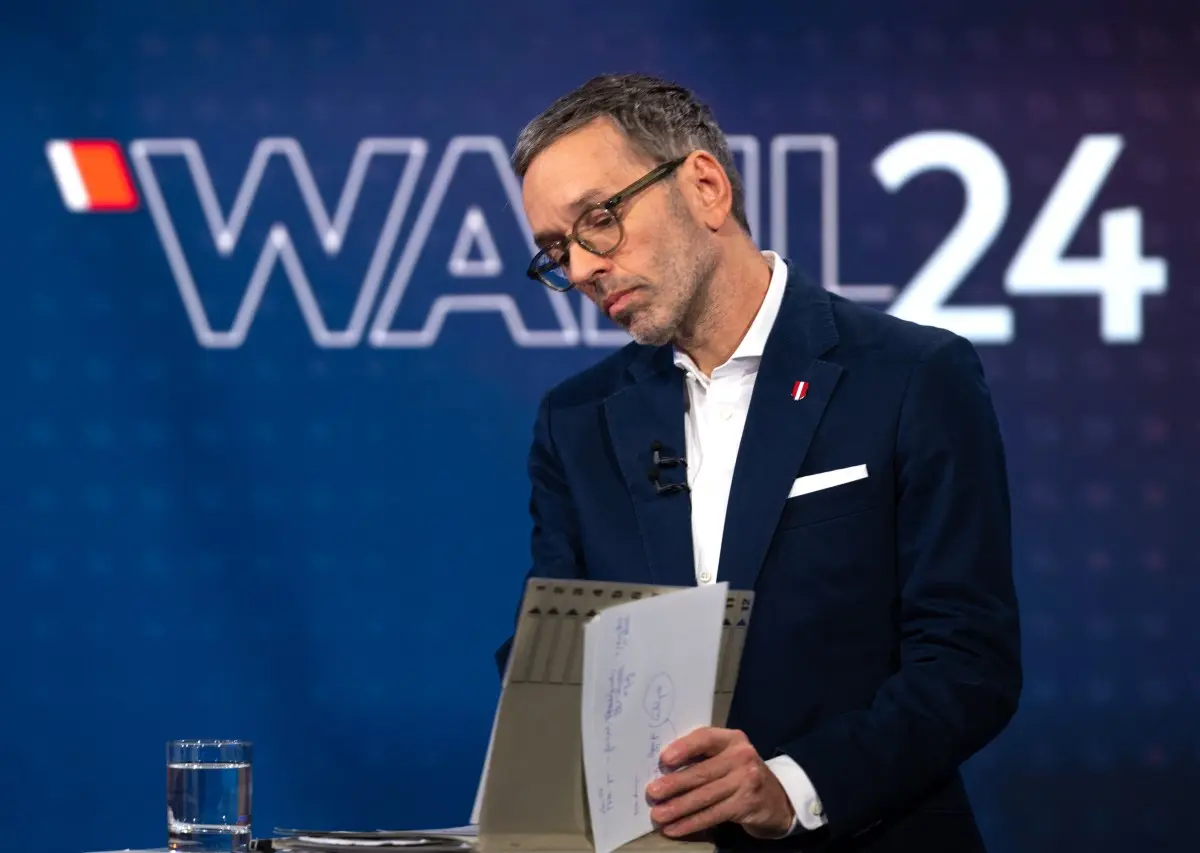
When Austria's far-right Freedom Party (FPÖ) went into government 24 years ago it drew international condemnation, marking a watershed moment long before the rise of populism in Europe.
The taboo on the far right in government was broken when the party founded by former Nazis became a junior coalition partner after taking 27 percent of the vote.
Its arrival under the flamboyant Joerg Haider led to the European Union's first sanctions on a member state and saw a quarter of a million people taking to the streets of Vienna to protest.
But the party also governed between 2017 and 2019, again with the conservatives, and is now predicted to narrowly win Sunday's general election, according to the polls.
But despite having electoral success long before the current rise of populist ideas throughout the West, the party's "experience in government has not been a happy one," said political scientist Thibault Muzergues, who has written a book on post-populism.
Once in government, the party has "regularly disappointed its voters" because of the concessions it had to make, said Muzergues.
Thus its support has fluctuated between 10 and 30 percent.
BACKGROUND: Why is support for Austria's far-right FPÖ rising?
Influencing the debate
The FPÖ's last spell in government ended in 2019 with the spectacular “Ibiza-gate” corruption scandal.
Despite the setbacks, the party has left a lasting mark on Austrian politics, making its opposition to immigration mainstream while other parties "refused to deal" with the issue, Muzergues said.
But according to Alexander Pollak, of anti-racism group SOS Mitmensch, the party's influence has been limited, as Austria still "remains a country of immigration".
The Alpine country has one of the highest proportions of foreign residents in the EU, he said.
However, Pollak argued that the FPÖ has successfully defined and restricted conditions for Austrian citizenship.
READ ALSO: Austria's far-right aims to suspend granting of citizenship to 'non-Europeans'
According to Eurostat, only 1.2 out of every 100 foreign residents in Austria obtained citizenship in 2022, compared with 8.8 in Sweden and an EU average of 2.2.
The laws have been tightened to such an extent that "even people born in Austria" remain foreigners, and fewer and fewer residents are able to vote.
In Vienna, a third of voting-age people are not allowed to vote, and across Austria, one in five is excluded -- a phenomenon that is "damaging democracy" bit by bit, said Pollak.
The party has also influenced how "Muslims are treated" in Austria, with conservative chancellor Karl Nehammer "no longer daring" to extend his Eid wishes (wishes typically extended to the Muslim community on the day marking the end of the month-long dawn-to-dusk fasting of Ramadan) to the community due to pressure by the FPÖ to "not treat them as full citizens", according to Pollak.
SOS Mitmensch said at least 20 speeches by FPÖ politicians -- some ministers -- during their last stint in government contained racism towards Muslims.
Overtaken by Orban and Trump
When former vice-chancellor Heinz-Christian Strache took the helm of the FPÖ in 2005, he sought to rally like-minded far-right parties internationally.
Viktor Orban, the prime minister of neighbouring Hungary, and former US president Donald Trump have since stolen the limelight. Their rise to power was a "turning point" for the global far right, said Pollak.
The FPÖ is "no longer a leader" of the far right within the EU, said Muzergues.
Its current head, Herbert Kickl, is "a subordinate of the big star Orban", he said, who likes to associate himself with ultra-conservative circles in the United States.
The FPÖ has also been overshadowed by "competition" from Italy's Prime Minister Giorgia Meloni, and the far-right Alternative for Germany (AfD) party in Germany.
But Austria might return to the spotlight if the far right wins the election with a leader who like Adolf Hitler, wants to be called the "Volkskanzler" -- the "people's chancellor".
Comments