
Christmas trees have a relatively short "life" span in Austria. Traditionally, they are decorated just on Christmas Eve (though this has been changing, and many families now decorate their trees well in advance) and are often disposed of by January 6th, the Feast of Epiphany which is when Catholics celebrate the end of the Christmas season.
If you bought a nice big Christmas tree, it's now time to start thinking about how to dispose of it properly.
Collection spots
Most cities in Austria will have signalled collection spots where you can dispose of your tree sustainably. In Vienna, there are 583 Christmas tree collection points (Christbaumsammelstelle) where people can leave their trees from December 27th to January 13th.
These trees will be sent to the Wien Energie waste incineration plant in Simmering and given a "second life" as fuel for electricity and district heating generation. According to the City of Vienna, some 140,000 trees were incinerated last year, supplying 1,300 households with electricity and 2,500 homes with district heating for a month.
READ ALSO: EXPLAINED: The new rules about recycling household waste in Austria
Other Austrian cities and provinces also have collection points. You can find the one in your village by googling Christbaumsammelstelle + the name of your town to check if there are collection points. In some, though, municipal workers collect the trees disposed of on sidewalks; you can find out if this is your case by searching for Christbaumabholung + the name of your village.
In all cases, people must remove all decorations (tinsel, candles, etc) beforehand.
Here is the information on all capitals:
- Eisenstadt (Burgenland): from January 7th to 14th, city employees remove the trees from the sidewalks from 7 am.
- Klagenfurt (Carinthia): the trees can be shredded and placed in the organic waste garbage can. City workers also collect trees left on sidewalks according to the waste collection schedule sent out to households in Klagenfurt.
- Sankt Pölten (Lower Austria): Christmas trees with a maximum height of 1.50 meters can be disposed of in the organic waste collection. Larger trees can be disposed of at any green container site. Alternatively, the Christmas tree can be crushed and filled into the compost bin, provided that there is enough space.
- Salzburg (Salzburg): trees placed in a spot "easily accessible for collection (such as next to the garbage cans)" are picked up based on schedules, depending on the city region. The recycling centre at Siezenheimer Strasse 20 also accepts Christmas trees free of charge.
READ ALSO: EXPLAINED: The new app helping people with recycling in Austria
- Graz (Styria): you can hand in your Christmas trees (without decorations) at the Christmas tree collection points in Graz until January 25th.
- Innsbruck (Tyrol): You can drop off your Christmas tree free of charge at the recycling centre at any time. City workers will also drive through the Innsbruck every day from January 12th to January 30th to collect the Christmas trees from the bulky waste collection points agreed with the property managers or homeowners.
- Linz (Upper Austria): The pick-up dates for Christmas trees are January 12th, 19th, and 26th. The trees should be without any decorations, not cut or chopped up, and disposed of on the evening before the collection day by the streets (not with the waste bins).
- Bregenz (Vorarlberg): From January 2nd, 2024, until the end of the month, citizens of the city of Bregenz can dispose of their Christmas trees at the designated collection points.
Other disposal 'methods'
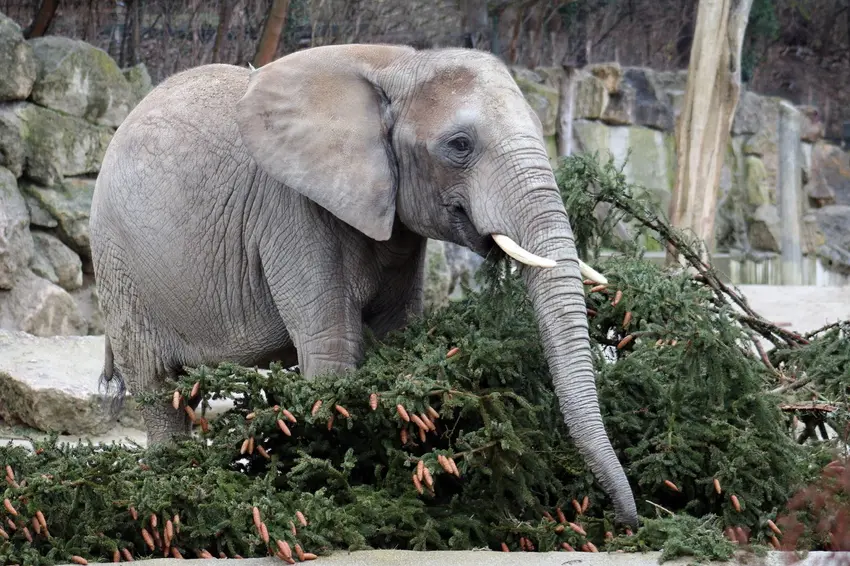
In Vienna, one tree disposal method in particular becomes an event in itself. The Christmas tree from the Schönbrunn Christmas Market is chopped up and served as a treat for the elephants in the Schönbrunn Zoo every year.
For those who do not have an elephant at home but do have gardens, the Christmas tree branches can be used to cover perennial plants and sprouting bulbs from frost. They can also be used as household compost, but the pieces should be at most 15 centimetres and should be as thick as a thumb, according to a Der Standard report.
People with chimneys could technically burn their trees, but before, they should consult a chimney sweep to find out if the appliance is suitable for burning the wood.
Comments