
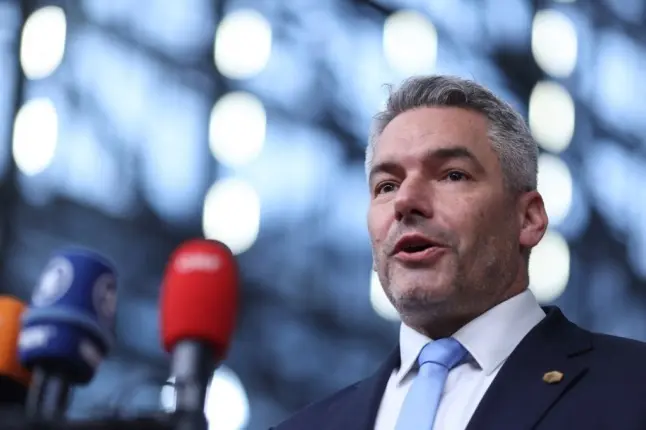
“We understand that cash is a very important theme to people,” Nehammer said Thursday. “It’s important to me that cash use is constitutionally guaranteed.”
Nehammer has tasked the Finance Ministry to come up with more concrete proposals ahead of a September roundtable with the national bank and banking industry. He’s also assembling a “Cash Taskforce” to come up with measures and work with other parties in parliament on guaranteeing the right to cash payments.
“Everyone should be able to freely decide how they pay for things,” says Nehammer. “Whether it’s with card, bank transfer – perhaps with the digital euro in the future – but also with cash.”
READ ALSO: Why is cash so important to Austrians?
According to national bank data, people in Austria withdraw €47 billion from cash machines every year, with Nehammer saying the discussions about restricting cash use “unsettle” people in the country.
According to the European Central Bank, about 70 percent of transactions performed in Austria in 2022 were carried out with cash – one of the highest rates in Europe. That’s higher than the eurozone average of 59 percent and higher even than the 62 percent of transactions in Germany that are done in cash – a country typically renowned for its Bargeld – or cash – obsession.
Austria also has an estimated 97 ATMs per every 100,000 residents. That too is higher than Germany’s total of 66 cash machines per 100,000 residents.
It’s not clear yet though what the actual measures to guarantee cash would include. The Social Democrats (SPÖ) say they want to be able to guarantee at least one ATM per community. But Nehammer says this proposal is too cumbersome.
The far-right Freedom Party (FPÖ) has previously called for a referendum on enshrining cash as a protected means of payment into the constitution.
Changing the Austrian constitution requires a two-thirds parliamentary majority – meaning the current ÖVP-Green coalition would require the support of at least one opposition party.
Comments